
There are incorrect views about open differentials in the Internet. To this point specifically, a cross-axle open differential provides exactly a 50/50 torque split between each half-axle at all times by design.
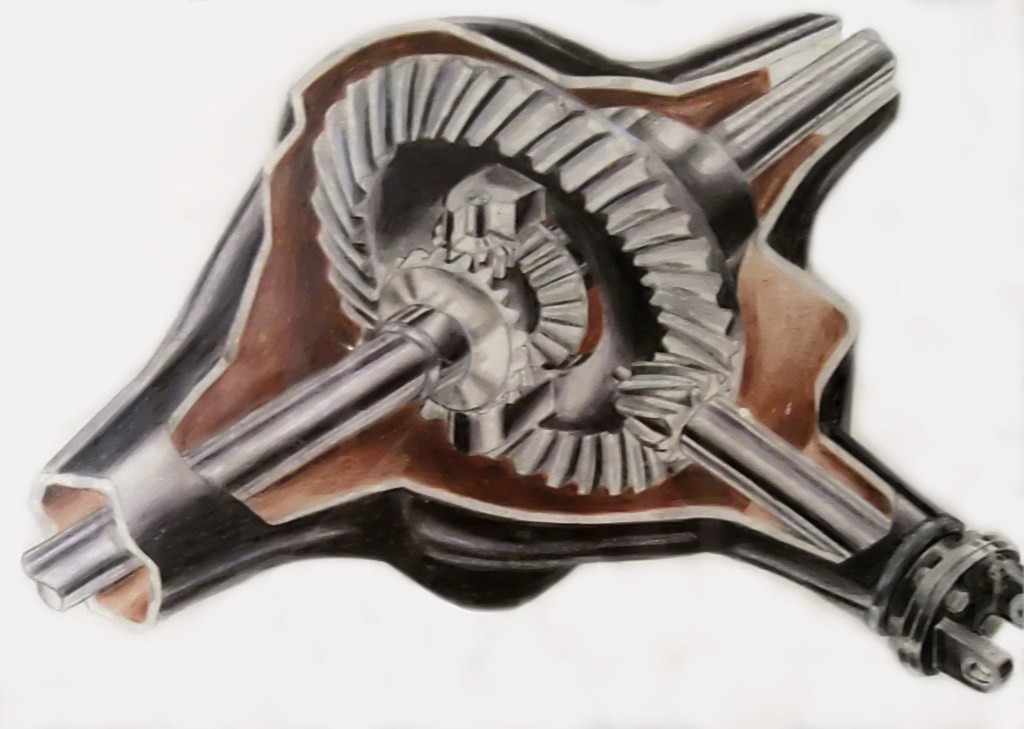
The differential’s role is to allow each half-axle to travel at different speeds, but the torque split across the half-axle ends is always equal, set by the ratio of the pinion and side gears.
You can Google that “torque split open differential” and there are lots of articles describing the mathematics and engineering behind this fact. Here is one, and here’s another, for example.
If one driven wheel loses traction there is no “torque leakage” out of that wheel. In fact the overall engine torque delivered (or load) drops immediately to zero (excluding parasitic drive-train friction). This is why the engine will rev-up (become unloaded) when a wheel(s) loses traction.
You can test how much reaction torque a free-wheel can produce in your garage by jacking up a front wheel (in 2WD) and using a torque wrench to attempt to loosen the wheel nuts. Measure how much torque you can achieve. This demonstrates that a free-wheel cannot produce a torque reaction.
Traction Control systems and clutch based LSDs use this equal torque split across the half-axles to generate traction, by adding brake friction torque to the free-wheel on the half-axle. This allows the engine to deliver torque to the free-wheel axle and, by design, exactly the same amount of torque to the other half-axle (with the wheel with traction) allowing the vehicle to proceed.
There are only two cases, I’m aware of, where the 50/50 split across the differential half-axles is not designed in. One in the centre differential of various Mercedes Benz AWD systems, where the axle side gears and pinions are built with different numbers of teeth to provide a torque bias to the rear (e.g. 60/40). The other is in Torsen differentials (such as Quaife, Peloquin, Eaton Truetrac brands) which use worm drive mechanics to multiply the torque (described as torque bias ratio) across the differential center.
Anyway, I just wanted to share that since the “torque-leakage” myth pops up all over the place and it is best to put an end to it.
 Gone Bush